
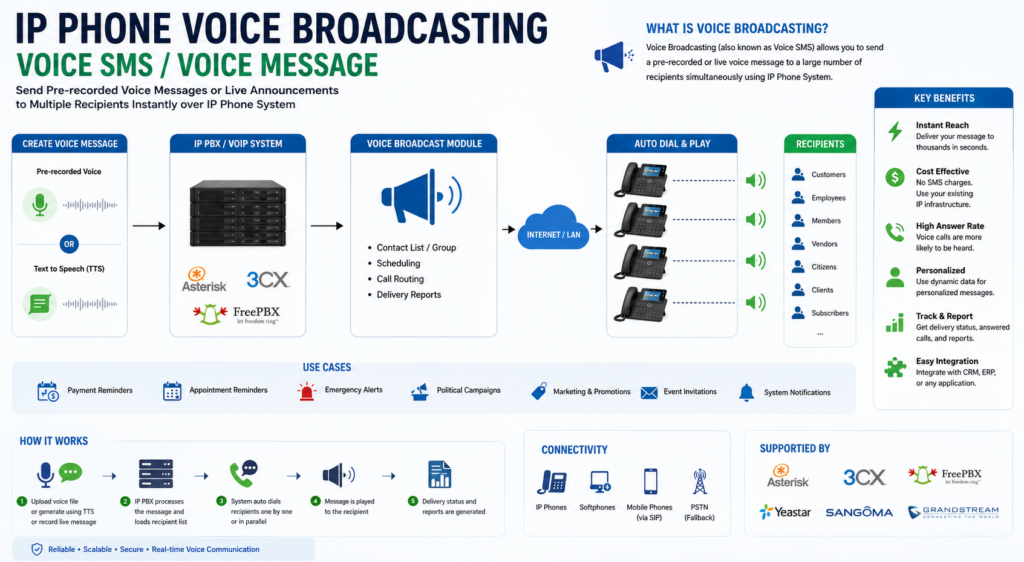
IP Phone Voice Broadcasting, often called Voice SMS, is a modern communication technology that allows businesses to deliver a single recorded voice message to a large number of people at the same time through an IP-based telephony system. Instead of manually calling each customer or sending individual messages, the system automates the entire process using VoIP infrastructure, making communication faster, more efficient, and highly scalable.
At its core, this system transforms how organizations interact with their audience. Whether it is a business announcement, a promotional campaign, an emergency alert, or a service notification, voice broadcasting ensures that the message reaches thousands of recipients within seconds, using the existing internet-based phone system rather than traditional telecom networks.
How the System Actually Works in Real Business Environments
The process begins when a business creates a voice message. This message can be recorded using a human voice or generated automatically using text-to-speech technology. Once the message is ready, it is uploaded into an IP-based communication system known as a VoIP PBX (Private Branch Exchange). This system acts as the central control unit that manages all communication flow.
Inside the PBX system, the message is connected with a contact database. These contacts may include customers, employees, subscribers, or any targeted group. The system does not call one person at a time; instead, it intelligently distributes the message across hundreds or thousands of simultaneous call channels depending on system capacity.
As soon as the campaign starts, the system automatically begins dialing numbers through the internet using VoIP technology. Each call is connected without human intervention, and once the call is answered, the recorded voice message is played instantly. If the call is not answered, the system can retry based on predefined rules such as time intervals or retry limits.
The entire process happens in a loop of automation—create message, load contacts, trigger broadcast, and deliver voice calls—without requiring manual dialing or call center agents.
The Role of IP PBX and Voice Broadcasting Engine
The backbone of this system is the IP PBX server, which acts as the communication controller. Popular PBX systems such as Asterisk, 3CX, and FreePBX are commonly used to manage voice broadcasting services.
These systems handle everything from call routing to message scheduling. The voice broadcasting engine inside the PBX is responsible for managing bulk dialing logic, ensuring that thousands of calls can be processed efficiently without crashing or overloading the network. It also ensures that calls are distributed evenly across available SIP trunks or VoIP gateways.
Communication Flow Through Network Infrastructure
Once the PBX system initiates the calls, the communication travels through an internet-based infrastructure. The voice data is transmitted over IP networks, passing through SIP protocols and VoIP gateways before reaching the mobile network. This means that the traditional telephone exchange system is bypassed, reducing cost and increasing speed.
The voice message is then delivered to the recipient’s mobile or landline phone as a normal incoming call. From the user’s perspective, it looks like a regular phone call, but in reality, it is fully automated and generated by a software system.
If the recipient answers, the message plays immediately. If not, the system logs the result and can trigger follow-up actions such as retries or reporting.
Why Businesses Use Voice Broadcasting Systems
The main reason businesses adopt IP voice broadcasting is because it provides instant mass communication with very high engagement. Unlike text messages that may be ignored or overlooked, voice calls demand attention. When a phone rings, most users naturally listen, which makes this method extremely effective for urgent or important communication.
It also reduces operational cost significantly. Instead of hiring call center agents to manually dial customers, businesses can automate thousands of calls at once using a single system. This improves productivity while reducing human workload.
Another important advantage is flexibility. The system can be used for marketing campaigns, appointment reminders, emergency alerts, OTP notifications, service updates, or even internal company communication. Everything is controlled from a single dashboard, making it highly efficient for both small and large organizations.
Technical Strength Behind the System
Under the surface, voice broadcasting systems rely on a combination of SIP communication protocols, VoIP gateways, and cloud or on-premise PBX servers. These components work together to ensure stable and scalable communication.
The SIP protocol handles session initiation between caller and receiver, while the VoIP gateway connects the IP system to traditional mobile networks when needed. The PBX server manages call logic, and the broadcasting module ensures that messages are delivered in sequence or parallel depending on configuration.
Because of this architecture, the system can scale from a few dozen calls to tens of thousands of simultaneous voice deliveries, making it suitable for enterprise-level communication.
Real Impact on Modern Communication
IP Phone Voice Broadcasting has changed how organizations think about outreach. Instead of one-to-one communication, businesses can now operate in a one-to-many model without losing personalization. Some advanced systems even allow dynamic message insertion, where customer names or account details are included in the voice message to make it more relevant.
As communication continues to evolve, this technology is becoming a core part of digital transformation strategies in industries like banking, healthcare, education, retail, and telecommunications.
In the future, voice broadcasting will likely become even more advanced with AI-generated natural voices, real-time interaction, and integration with intelligent CRM systems that trigger voice calls automatically based on customer behavior.
Final Thoughts
IP Phone Voice Broadcasting is not just a communication tool—it is a complete automation system that bridges voice technology with internet-based infrastructure. It allows businesses to communicate faster, reach wider audiences, and operate more efficiently than traditional calling methods.
For any organization looking to improve customer engagement and communication